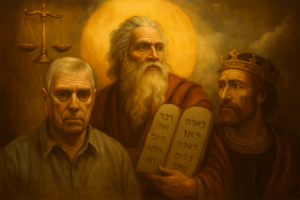
The British Royal Family can always be relied upon to grab headlines. Lately, it’s Prince Andrew’s accelerated descent from grace into obscurity that has captured attention. The family of the late Virginia Giuffre, who accused him of sexual abuse, say they are “proud of this normal girl from a normal family” who brought down a prince.
Whatever one thinks of Andrew Mountbatten-Windsor, this is a story of biblical proportions—one that mirrors the inner struggle we all face to confront and integrate our own shadow.
Consider David, the shepherd boy chosen by God to be king. I imagine him as tall, charming, and charismatic. He was a lusty bloke—just ask Bathsheba—and arrogant enough to send her husband to his death. Perhaps it seemed justifiable at the time, or simply something he could get away with.
Enter Nathan the prophet, the truth-teller who made it clear: David would not escape the consequences. Slowly, David awakened to the gravity of his actions. But even repentance didn’t shield him from loss. The child born of his betrayal died, and David was forced to face the wreckage he had wrought.
This is what I love about the Jewish scriptures: their heroes are gloriously flawed. Take Moses—raised in a palace, lacking nothing. Yet one day, in a fit of righteous fury, he killed a man and buried the body. Only after years in exile did he emerge as a leader, shaped by desolation and humility.
At rock bottom, we meet our demons. In that dark place, we are stripped of illusions and titles. We become, simply, human. And perhaps, if we’re lucky, we emerge with a more grounded understanding of ourselves.
I often reflect on this while facilitating restorative justice conversations in prison behind razor wire and steel grilles. As I witness people confronting their pasts I recognise that we’re all imprisoned in some way—by our beliefs, histories, or the patterns we’re too afraid to break.
Being forced onto the path of suffering can, paradoxically, become a gift. As Auschwitz survivor Viktor Frankl wrote, it’s not what happens to us that defines us, but how we respond—and the meaning we create from the ruins.
This journey inward may awaken something sacred. Some call it God. Others, a guiding force that leads them home to themselves. Whatever the name, it can equip us to make amends, even when forgiveness is uncertain or out of reach.
I don’t know if Andrew is guilty or the scapegoat necessary to maintain the royal family’s persona. It’s not my place to judge. What I do know is that the journey inward, whether for a prince, prisoner, victim or any one of us, is not for the faint hearted.
Yet that journey offers something more enduring than coronets, costumes, titles or fame. It offers the possibility of moving towards wholeness, something most of us yearn for. Whenever it appears like the dawning of a new day, I’m certain I can hear Leonard Cohen crooning hallelujah, hallelujah.


I wonder if our demons are behaviours or feelings/desires. In your examples above the people concerned did ‘bad’ things, they didn’t just imagine them. Or maybe there is a third option – our demons are the shame or regret we feel in relation to what we’ve done in the past. I wonder if the great sinners of the past even had demons as they require some level of remorse.