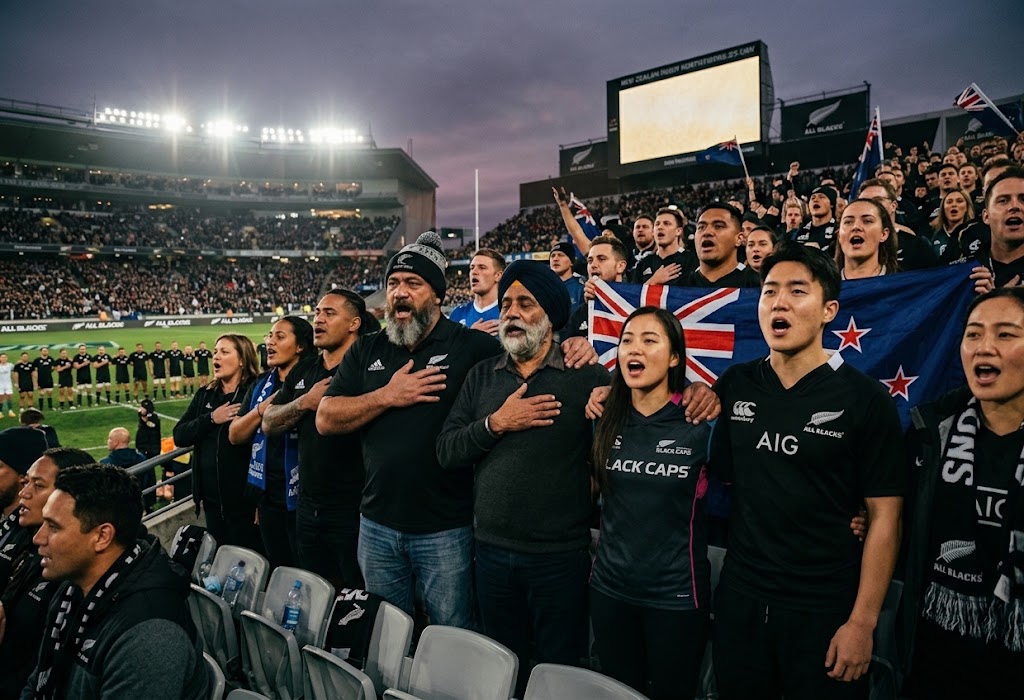
New Zealand, like many countries, appears to have no shared mythology capable of uniting disparate groups.[i] Some people believe Christianity once did this. Others claim Christianity was a colonial imposition on indigenous ways of knowing.
This wondering was brought on by singing the National Anthem at a family values conference. Not my normal habitat but they had fascinating speakers so there I was.
As we sang, led by rugby great Eroni Clarke, first in Māori and then English as is our Kiwi custom, a profound sense of belonging and connectedness flowed through me. I was home and knew that whatever divided us, which appears to be plenty, could in this moment, be held in tension with dignity.
This contrasted with another meeting to discuss spirituality in healthcare research. The gathering was diverse; but the opening rites, as often happens, were exclusively Māori and facilitated by a visiting kaumatua. Respect was shown by the Christian chaplains present even as their extensive spiritual experience was effectively sidelined. I felt polite indifference, which interested me.
The public revitalisation of indigenous spirituality is valuable. However, through 15 years as a hospital chaplain, I observed that Health New Zealand’s persistent embedding of Māori rites and rituals was enforcing a civic religiosity. This required at least token submission or adherence in what is meant to be a secular workplace. [ii] And strangely, all happening as I was advocating for hospital chaplaincy beyond religious control.
After these meetings, my feelings of connection and indifference jostled about within, a bit like Cain and Abel those famous twins whose relationship ended in tragedy. Eventually, some tentative understanding dawned.
Like other national anthems, New Zealand’s began as a poem. There is a transcendent element to it that invites us to honour a power greater than ourselves and uses the code word God for that. It helps us imagine being connected in love while free from strife and war – the idealistic dream of all humanity. The anthem has mythic qualities.
A myth is not a lie, as is commonly believed, but a myth must never be taken literally although it reveals truth known for all time. Mythology “is a system of images that endows the mind and the sentiments with a sense of participation in a field of meaning”, [iii] which is what happened to me.
When singing a myth something important happens, which is beyond rational understanding. Defences go down; we see the world differently and possibilities become endless despite our muddled attempts at world peace. Momentarily the ego can shift from the power position into a more realistic place where humility is possible.
Nothing good comes from forcing people to exhibit adherence to belief systems that are not their own. Staggering through endless iterations of forcing compliance is how we got to the secular state where we can hold religious beliefs but not force them on others.
Perhaps rejuvenating poetic anthems could help us mix and mingle mythologies in the often fraught public square – time will tell.
[i] Joseph Campbell, Thou Art That: Transforming Religious Metaphor, New World Library, 2001, p95
[ii] Sande Ramage, Hospital Chaplaincy and New Zealand’s civic religion
[iii] Campbell, p8.

