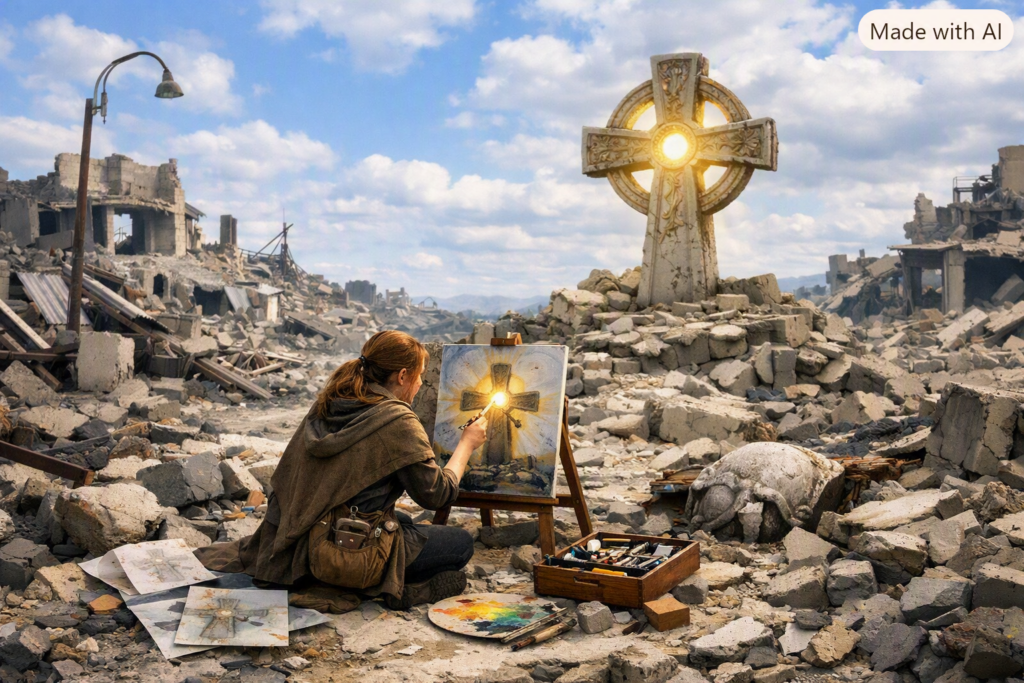
Crosses are everywhere, planted at roadside crash scenes, prominent on churches and flags, decorating jewellery and tattooed on bodies. A colleague reckons the meaning of a cross is, “pretty obvious and fundamental”, but I’m not so sure.
After years of listening to ‘non-religious’[i] people reaching for meaning amid misfortune, I’m aware that symbols are alive, never completely understood, nor set in theological concrete. They have a resonance that invites exploration beyond preconceived ideas or organisational edicts about what they are supposed to mean.
Exploration beckoned when I encountered Fritz Koenig’s crucifix in the Protestant Chapel at Dachau concentration camp memorial site. At first glance it’s nothing much – dark brown and heavy – not exactly inspiring. There’s a figure struggling to break out of a confining cross, but hard to see properly. Despite that I kept being drawn to it.
Back home in New Zealand I couldn’t let the image go. I kept a picture of it on my desk, which I repeatedly ripped up in frustration. Then one day, on a whim, I asked CoPilot to lighten it up. When I saw the result, I shouted, “that’s me”.
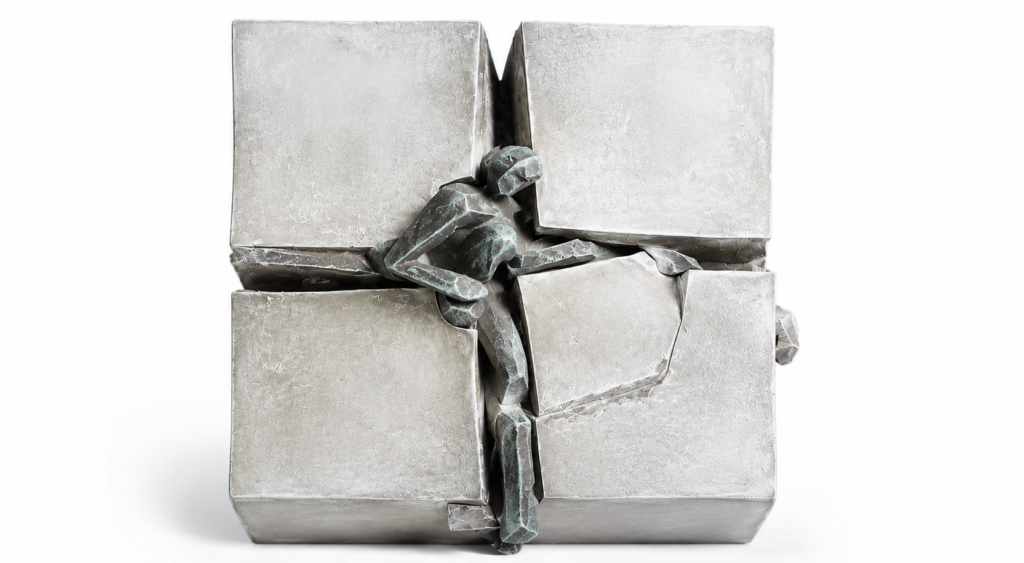
I assumed this related to my ongoing struggle with religion and God. But then a strange thought welled up. Could there be a broader human struggle with religion, God and the symbols domesticated by Christianity, which I had inadvertently stumbled into.
For me, the religious impulse is a vital life force that doesn’t adhere to a creed or set of proscribed beliefs. Instead, it’s more like an act of co-creation engaged through mythos, art and music.
Although I love the intellectual pursuit of theology, it takes me down the seductive pathway of compliance where I try to get approval by offering up the currently agreed academic, historical or church truth.
Whereas my method is more chaotic, sometimes combative, and often intuitive. What author and psychotherapist Thomas Moore calls a process of creating one’s own religion, by “centralising the imagination rather than logical and factual language”. [ii]
Now it seemed that this creative force was being ignited again through a symbol, found in Germany – in Dachau, the model for all later concentration camps.
In Religion as Metaphor, David Tacey suggests that humans cannot live without a mythos and “when one is torn down, others rush in that are by no means better than the ones they replace”.[iii] And that Germany “found itself … taking on nationalism as a pseudo-religion”, [iv] once Christianity was weakened as rationality undermined belief.
Christianity is at a crossroads in the Western world. Knowing it holds a magnificent and transformative mythos without actively teaching how to understand the sacred through metaphor and myth. However, being timid about challenging literalism leads to collapse. As Tacey says, “we cannot continue to promote a false view of scripture because we are afraid to face truth”.[v]
Koenig’s symbol challenges literal belief. Perhaps he knew that if we cannot remythologise the Christian story, it would lose transcendent power. Truth told, he’d already lived through that destruction.
[i] As a hospital chaplain the first thing people wanted to tell me was that they weren’t religious before talking at length about spiritual and soul of great meaning to them.
[ii] Thomas Moore, A Religion of One’s Own: A Guide to Creating a Personal Spirituality in a Secular World, Gotham Books, 2014, p173.
[iii] David Tacey, Religion as Metaphor Beyond Literal Belief, Transaction Publishers, 2015, p210
[iv]Tacey, p210.
[v] Tacey, p213.


Always a wonderful exploration. Thanks!